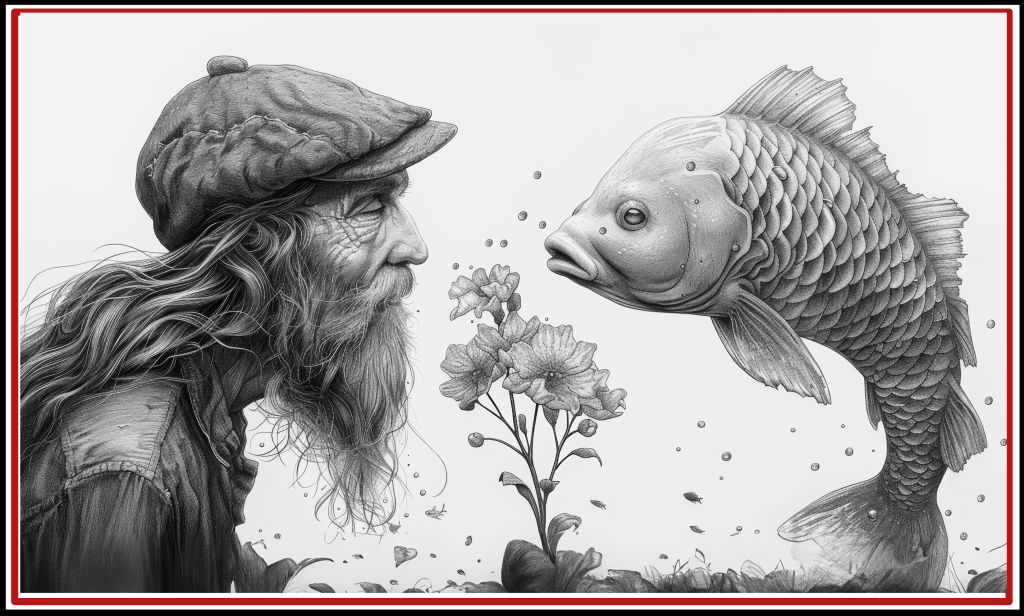
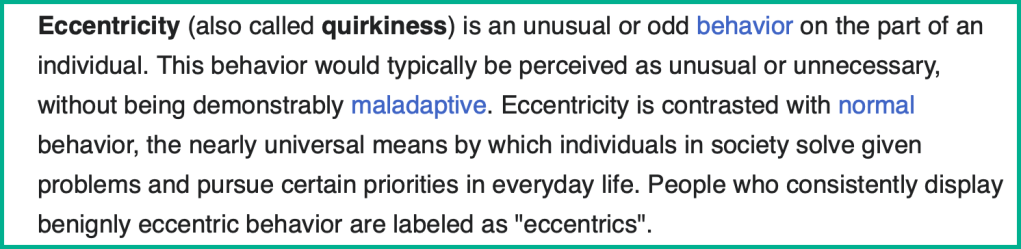
For this in-depth look I want to study eccentricity. Yeah, I know when you try to look this topic up you usually see bunches of circles. That’s not the eccentricity I’m talking about. Let me go to Wikipedia for their explanation of the word.
What has brought up the topic of eccentricity is that about 10 years ago I had a personal epiphany that I am an Aspie. At the time it just seemed to fit. But then the medical community got the idea to just merge many different “abnormal” characteristics into one field called Autism. That made it easier to handle from their perspective. They say Autism is a spectrum that ranges from severe childhood disability at one end to being a highly intelligent savant at the other. Sadly, the vast majority of people only see one aspect of Autism, and that is of a very young boy on the left end of the spectrum who is crouching alone in a corner twiddling his thumbs and mumbling. To the medical community, that person needs “fixing” and, therefore, so must the rest. To them, there is nothing normal about any part of Autism.
I still recognize that I have many of the characteristics of Autism, but acknowledging that fact seems to do nothing to help me along my life journey. Maybe it is time to take on a different label. One that mostly fits, but without all the detrimental baggage. I know there are plenty of sub labels attached to being eccentric, such as weird and crazy, but at least the medical community is not actively trying to “cure” eccentrics… yet. It is presently just a description of a class of people that they haven’t gotten around to analyzing yet.
I will be taking a stroll through the topic of Eccentricity. Of course, the internet has provided some information on eccentricity, but there are two books that I am currently reading will likely provide most of the fodder for this new study.
Maybe I am an eccentric, maybe not.
Call me eccentric if you like, but regardless of the validity of that label, looking into eccentricity sounds kinda fun so that’s what I plan to do in this in-depth project..
I have gathered more than enough info to make the subject of Eccentrics interesting. Since this is not a doctoral thesis, but instead just an old guy trying to live up this mantra “Never Stop Learning”, I will not fill these words with footnotes. If you are interested in learning the source of info, send me a comment and I will try to identify it for you.
I have accumulated over 50 characteristics of what a typical eccentric might look like. The seven characteristics below are seen by those who have studied the subject as being central to the definition of an eccentric. I will look at each of them in this project.
- Nonconforming
- Creative
- Curiosity
- Idealistic
- Intelligent
- Opinionated
- Outspoken
The first book I studied is entitled “Eccentrics” by David Weeks & Jamie James.
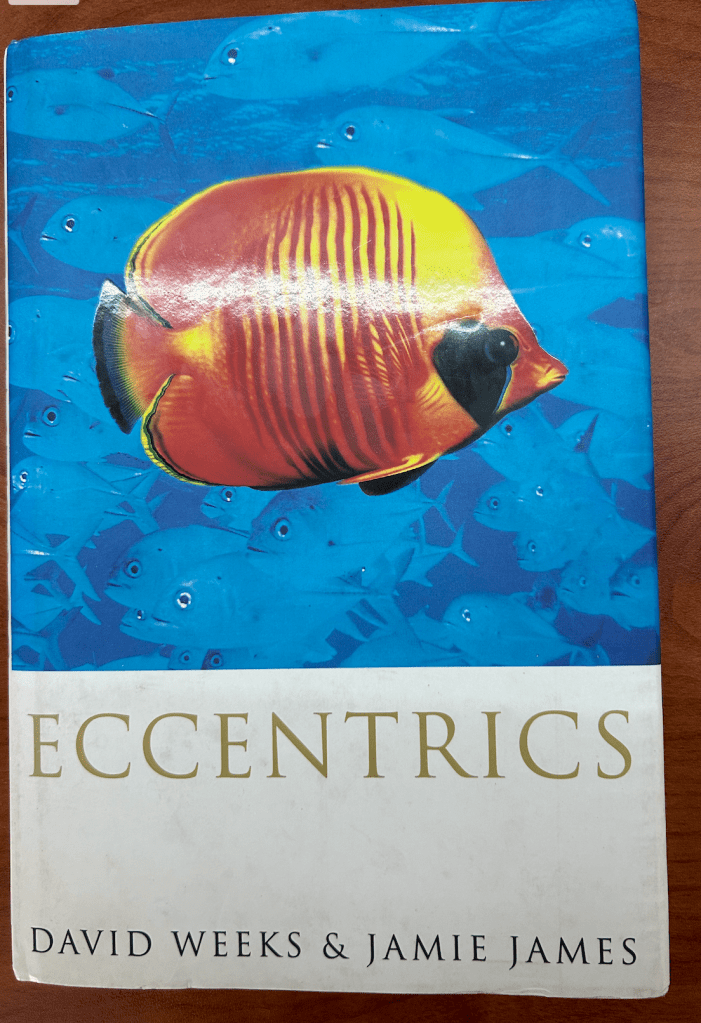
David Weeks was a clinical neuropsychologist and therapist practicing at Royal Edinburgh Hospital in Edinburgh, England when the book was written in 1995. At that time, he was the first scientist to conduct a systematic study of eccentrics. He studied and interviewed over a 1,000 such people all over the world. He compiled a fascinating profile of what he sees eccentricity really means. His research is central to this project.
I did plenty of searches to try to find other scientific studies of eccentrics but found none except for this one that was based on any type of scientific method. But, what I did find is that England is far and away the capital of the world when it comes to eccentricity, the Brits take great pride in that fact. That will become more obvious as we get deeper into this subject.
The second book I read is entitled “Eccentricity – Society’s Secret Sauce – The Value of Being Eccentric” by Brett Sinclair.
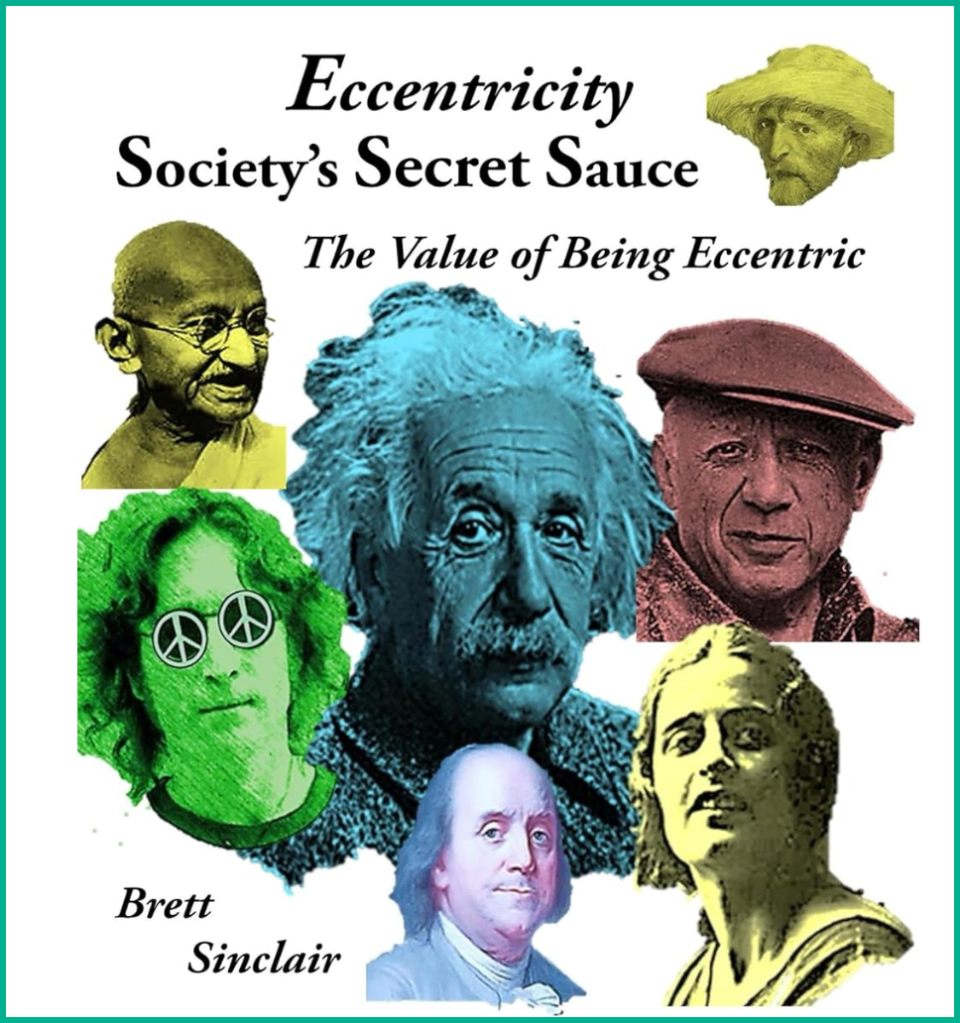
The author holds a degree in History and a J.D. from a top ranked U.S. law school and is now a successful lawyer who has traveled to over 50 countries.
One of the quotes from the introduction of his book:
I decided to write this book because I am passionate about the value of eccentric people after discovering a paucity of books on this fascinating subject.
This book turned out to be just a repeat of the first book. But the author’s 12 stories of eccentrics were enjoyable to read, but didn’t add much to the study.
Everyone Wants To Be Eccentric
Almost everyone, to one degree or another, wants to be different from those around them. Absolute, uniform conformity, if it even existed, would be boring as hell. Never having different thoughts than the herd around me would be personally intolerable.
The other issue is just how much deviation does it take to be considered eccentric, and how do you even define eccentric? I hope to at least partially answer these question.
I am a scientist who needs proof. Myth, folklore, or old-wive’s tales just don’t hack it for me. I need verifiable controls and scientific methods. To my knowledge, there has been only one book that meets these requirements and that is one by David Weeks. Hopefully, I will find others as I go through this series.
You could say that eccentric is the opposite of normality. But, that makes the question even more difficult, as normality is one of the most subjective issues in life. One man’s normal is another’s insanity.
One part of eccentricity is just how much each social culture allows differences. What is acceptable behavior in California might be considered at best rude in Alabama, and vice versa. What is normal to me is certainly not normal to the majority of those around me.
Eccentricity is at least partly a matter of choice and that choice takes a brave person to choose. I don’t know at what point in my life that I decided that being outside the mainstream was better than being in the middle of a herd. That transition might have occurred, like most others, in my early teenage years, but likely earlier, when I was teased or bullied because of one difference or another.
From David Weeks study, claiming the label of “eccentric” for those who are truly eccentric is a pleasurable thing. They don’t lament their differences in any way, but instead celebrate them. It has been found that, generally, eccentric people are “happy” people who very much enjoy life in their private lane. I kinda think I belong in that category. That is in stark contrast to those who depressed due to some of those same traits.
If the medical establishment ever gets hold of eccentricity, I suspect they will try to “cure” it, so those people can be as miserable as the rest of us. We just can’t have all that uninhibited happiness floating about, can we?
The Short List
As mentioned previously, I have accumulated a list of about 50 characteristics that some who have studied the subject consider eccentric. I will give you the top 8.
The first 5 in this list are considered the most important and applied to virtually every eccentric in the David Weeks’ study. The other 3, although not in every eccentric, are close behind.
- Nonconforming
- Creative
- Curiosity
- Idealistic
- Obsessed with their “Hobbies”
- Intelligent
- Opinionated
- Outspoken
• 1 Nonconforming – All Eccentrics take great pride in not conforming to the norms of society. It is their principle defining trait. It gives them a sense of freedom from the constraints of everyday life. They proudly and obsessively go their own path in life. “Herd mentality” is assuredly the most ugly phrase in the English language to them.
• 2 Creative – This is close behind to nonconformity. They have excellent imaginations and original ideas. Sometimes extremely original.
• 3 Curiosity – Curiosity is a strong desire to learn something. My mantra in life is “Think For Yourself, Question Everything, Never Stop Learning”. That obviously included the first three from this list.
• 4 Idealistic – A true eccentric wants to make the world a better place, and the people in it happier. In this regard, EVERYONE should be eccentrics.
• 5 Obsessed with their “Hobbies” – Of course “hobbies” means things that they take extreme interest in. They spend hours, and sometimes days/weeks/months at a time on them until their curiosity is appeased. These hobbies sometimes come 5 or 6 at a time.
Later in this study I will go into examples from the Weeks book of those who prominently demonstrate these five characteristics. As I mentioned above, all who are clearly eccentric almost always conform to the first five. Let’s continue on to the next three on this list as this completes many others lists who have studied eccentricity.
• 6 Intelligent – Curiosity is the only human motivation that is primarily intellectual. One of the examples of someone who was obviously eccentric is Albert Einstein. He was obviously intelligent as his IQ was estimated to be around 160. 137 – 160 is considered the top 1% of intelligence.
• 7-8 Opinionated & Outspoken – Eccentrics are convinced that they are right and the rest of the world is just out of step.
From what I have learned so far, I am convinced that eccentricity has been with us in some form since the beginning of history. It wasn’t until one of those eccentrics had the wherewithal to invent the wheel that things finally started rolling along.
Some Eccentric People
It’s time to give you some background and stories about those considered eccentric in the 19th and 20th centuries.
But first let’s look at a couple of people of that period to see what they said about the subject subject of eccentricity.
John Stuart Mill (1806 – 1873) who was a well known English philosopher wrote “”the amount of eccentricity in a society has generally been proportional to the amount of genius, mental vigour, and moral courage which it contained” and he mourned a lack of eccentricity as “the chief danger of the time”.
Edith Sitwell (1887–1964) who was a poet with very eccentric parents, wrote that eccentricity is often a kind of innocent pride and that geniuses and aristocrats are called eccentrics because “they are entirely unafraid of and uninfluenced by the opinions and vagaries of the crowd“.
You could say that eccentricity’s modern birth was Britain. The thought behind that is due to the massive aristocracy of that country in the 19th and 20th centuries. The largest percentage of eccentrics were the landed gentry. They were basically afraid of nothing and couldn’t care less about the rest of the world outside their individual kingdoms. When who you are born to is the total deciding factor of how your life will be, everything else just doesn’t matter. Even today, there is a by-invitation-only Eccentric Club in London that was founded in 1781.
Let’s switch gears now and look at some famous people who met the requirements of being eccentric and talk about a couple of them:
Eccentric People
- Martin Luther
- Vincent van Gogh
- Ben Franklin
- Lord Byron
- Albert Einstein
- Nikola Tesla
- Winston Churchill
- Pablo Picasso
- Mahatma Gandhi
- John Lennon
- Davy Crockett
I’ll pick a few on this list for further observation.
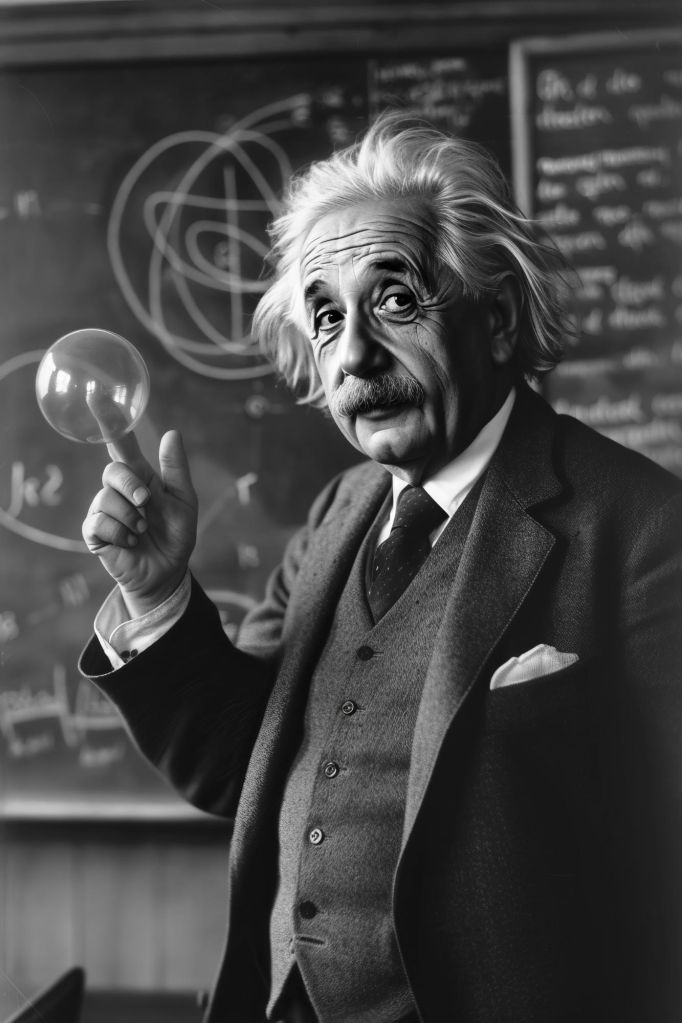
Albert Einstein – My first “big boy” book that I read at the age of 11 was a biography of this quirky character. His hair alone gives you a good idea of his individuality. As I have mentioned before, one of the most enduring qualities of true eccentrics is that they are, for the most part, happy people. I think Albert, especially in his final Princeton University years, was probably at the top of this list.
- He had a very large head and obviously a brain size to go along. I share head size with him. I have never tried on a hat that was too big for me.
- He enjoyed playing unique practical jokes on all his friends.
- He ate live grasshoppers to gross out his friends.
- He regularly smoked cigarette butts he picked up off the street.
- He never wore socks and bragged about it.
- Obviously, he was very intelligent, and his curiosity was without bounds.
- He was definitely nonconforming.
- When he wrote about all his various theories, the scientific community, almost totally rejected them.
- He enjoyed crying. He said it cleared his sometimes malaise.
Vincent van Gogh– Another person I seem to have naturally aligned with eccentricity was Van Gogh. He was a very prolific painter in the 1870s and 80s. His painting that drew me in was Starry Night. It just spoke to me like no other had before. I have had a copy of that picture on my wall since the 1960s.
Here is a prominent quote from him about his struggles for recognition.
What am I in the eyes of most people – a nonentity, an eccentric, or an unpleasant person – somebody who has no position in society and will never have; in short, the lowest of the low. All right, then – even if that were absolutely true, then I should one day like to show by my work what such an eccentric, such a nobody, has in his heart.
They speculate that one of the primary reasons Van Gogh committed suicide at the age of 37 was that he suffered from vertigo and tinnitus (the room spinning and constant ringing in his ears). At about the same age, I too, started suffering from those conditions. I went deaf 3 years later, so I will certainly attest to how those two conditions can be debilitating.
Davy Crockett – This one was a surprise to me. According to folklore he was a quintessential American frontier hero who was very frequently described as an eccentric by his contemporaries. A nurse at the Alamo described him as
He was the strangest man I ever saw. He had the face of a woman and his manner was that of a girl. I could never regard him as a hero until I saw him die.
Let’s now hear from those wiser than us on the topic of eccentricity
To become a person does not necessarily mean to be well adjusted, well adapted, approved of by others. It means to become who you are. We are meant to become more eccentric, more peculiar, more odd. We are not meant just to fit in. We are here to be different. We are here to be the individual.
James Hollis is an American Jungian psychoanalyst, author, and public speaker. This quote suggests that all of us should eventually become an eccentric. Given what I have learned about this topic, I quite agree.
I am not eccentric. It’s just that I am more alive than most people. I am an unpopular electric eel set in a pond of goldfish.
Dame Edith Stillwell was well known for her poetry, and was outspoken on several topics. I love the words above about being an electric eel set in a pond of goldfish. Another quote she was famous for is: I am patient with stupidity but not with those who are proud of it. I couldn’t agree more.
You must not blame me if I do talk to the clouds.
There’s a fine line between eccentrics and geniuses. If you’re a little ahead of your time, you’re an eccentric, and if you’re too late, you’re a failure, but if you hit it right on the head, you’re a genius.
Thomas Watson, Jr. – American businessman
I will close out this section with the complete list I have found that defines eccentric qualities. As I mentioned before, the top 10 are them most essential to being an eccentric. The rest are just carry-ons
Eccentric Qualities
- Nonconforming
- Creative
- Curiosity
- Idealistic
- Intelligent
- Opinionated
- Outspoken
- Unusual eating habits
- Unusual living arrangements
- Not interesting in the company of other people
- Not interested in opinions of other people
- Mischievous sense of humor
- Single
- Usually eldest or only child
- Bad speller
- Byronic hero
- Original thinkers
- Have a strong sense of self
- Have less social anxiety
- More authentic
- Less interested in conforming to social norms
- Shrug off expectations
- Defying peer pressure
- Attract haters
- Not interested in following the crowd
- Not afraid to stand out
- At ease in your own skin
- Not worried about criticism
- Not worried about other’s perceptions
- More alive than most people
- Electric eel in a pond of goldfish
- Become who they are
- Are just not meant to fit in
- Focused on being unique
- Virtuous
- Not afraid to talk to themselves
- Have uncommon abilities
- Innocent pride
- Not interested in the vagaries of the crowd
- Ahead of your time
- Are a genius
- Given up trying to be normal
- Solitary
- In big things, genius; in small things, crazy
- A nonentity in the eyes of many people
- Unusual childhood
- Happily obsessed with unusual subject
- Mischievous sense of humor
- Show compassion
- Innocent pride
- Unafraid of opinions
- You like being different
- You have an off-beat sense of humor
- You are empathetic towards others
- You enjoy solitude
- You embrace your individuality
- You are a passionate person
- You look at things from a unique angle
Some Loose Ends
Let’s spend som time covering some loose ends that I simply have to tell you about.
Eccentricity And Mental Health
The David Weeks multi-year study of Eccentricity covered years and about a thousand case studies. Throughout the study, he and his researchers made a continuous effort to distinguish between eccentricity and the forms of mental illness which mimic it. He used another study’s list of symptoms of schizophrenia to look at the correlation between these two conditions. Generally, what he found was that eccentrics likely have fewer schizophrenics than the general population. Given that Weeks study only contained 1,000 cases, this is not yet a proven hypothesis.
Eccentric Childhood
Eccentricity is at least partly a matter of choice which requires considerable bravery. Weeks discovered that at least ⅔ of the eccentrics in his study knew by the age of 8 that they were different from everybody else, but in most cases, they kept that to themselves for years before they felt confident enough to express it.
One fact that was interesting to me was that most eccentrics experienced prolonged periods of isolation in their childhoods. Many times this was because of being ostracized by their peers. They just found their own company better than being with others. Another surprising finding from the study is that the emotional atmosphere in the home was of crucial importance to development of the eccentric personality.
Most children who later become eccentric have frustrations of not being treated fairly. These frustrations often occur when they initially go to school. Let’s face it, school system, by their nature, rewards conformity. Young eccentrics often question their teacher’s actions rather than conforming to what they say. This often gets them in trouble. It is interesting that Einstein give a very similar story from his childhood.
Sense of Humor
Here are some words from Week’s book describing eccentrics sense of humor:
Eccentrics can be extreme in the exuberance with which they express their sense of humor. Eccentrics humor is broad in scope, embracing the gentle as well as explosive.
Eccentrics and Health
More words from the Week’s book:
What was most surprised was, with few exceptions, the subjects in my study were happy, even joyful people, and their joy was infectious. Eccentrics are simply happier than most of us.
He also found that eccentrics are largely immune to the physiological toll of stress because they don’t feel the need to conform and are not concerned about how the rest of the world views them.
David Weeks closed out his book with the following paragraph
By flouting norms of behavior that most of us never question, eccentrics remind us how much of our own liberty we needlessly forfeit, and how great is our ability to forge our own identities and shape our own lives if only we will use it.
I was surprised how this 1995 study into eccentricity was very enlightening to me.
A Self-Evaluation
The word “eccentric” has drastically flip-flopped throughout history. Sometimes it has carried a negative connotation as meaning “weird”, and even mentally ill. Other times it is used to label those who are truly innovative and creative thinkers of their times. From my studies, I can assure you that people don’t reach astonishing levels by playing it safe, or striving to be part of the herd.
Yes, some eccentric people are likely mentally ill, as with everyone else, eccentric people are not excluded from that condition, although according to the David Weeks study they are actually less likely to be mentally ill than is the mainstream.
I was kind of surprised that some people plainly hate eccentric people. But, since eccentrics are always mixing up the flow, that greatly disturbs people who strive to stay safely hidden in the mainstream.
I spent a few weeks doing a self-evaluation of things often considered eccentric that I have great pleasure doing or being. Here is my list, but I before do that I want to tell you that, for the most part, eccentric people have much the same human emotions as almost everyone else. It is the intensity that I think differs.
Finally, here is the list, kind of in the order of importance to me.
•1 – I am very emphatic towards others, especially those who struggle in life.
I have faced significant challenges throughout my life., and to one degree or another, I have overcome them, but when I see stories of people struggling, it is almost as if I am by their side facing their struggles with them. These are probably the strongest feelings I have had as a person.
•2 – I look at almost everything from a different angle
For several decades now, my life mantra has been “Think For Yourself, Question Everything, Never Stop Learning”. These characteristics almost demand that I look at things from a different angle, and indeed I do.
•3 – I enjoy my solitude
My mind DEMANDS a certain degree of solitude. I just have to get away from people, and throw off the masks that are required for socializing and other such mundane things. I have been basically alone for the last 3+ years now and, for the most part, enjoy being able to do what I want when I want and how I want.
• 4 – I abhor even the thought of being part of the “herd”
I guess being like everyone else is fine for most people. They want to be part of a group, no matter what its name is. Their herd could be a church, a country club, or just a group of friends that get-together regularly. As the old TV show “Cheers” said, we just want to go where everyone knows our name.
Personally, I don’t often have that desire to any degree. I know I am different, and I am finally able to celebrate that fact. To just follow the back end of the sheep in front of me is something I threw off years ago.
•5 – I finally consider myself to be a creative soul
I enjoy doing, thinking, and seeing things from a different angle. My blogging, photography, and artwork make me feel creative.
•6 – I am mostly passionate about the projects that I do
When I get into the “projects” mode in my life, I usually go at them “full steam ahead”, often excluding almost anything else. Because boredom is constantly shadowing me, I am always seeking that next great thing to fend it off.
•7 – I am a free thinker
I pride myself on always thinking for myself. It is almost as if my place in life is to be a contrarian, and therefore I start many sentences with the word “But, “.
•8 – I like being Unique
One of my past projects was to figure out how unique I am. In just looking at two factors of my life, being a deaf and an Aspie, means that I am 1 in 160,000. If I take in all my other characteristics, I am probably 1 in a million. I revel in that thought.😎
•9 – I overthink and worry too much
When you analyze something too much, you simply end up grinding it into almost meaningless dust. Of course, this is not an asset, but is instead a liability that I just can’t seem to shake.
•10 – I can’t look people in the eyes
This is one of the things that convinced me that I am Autistic and is not included in being an eccentric. To me, staring into someone’s eyes is almost the equivalent of looking into their soul, and that is something I have never been able to do.
Closing Thoughts.
Let’s close out this in-depth project covering eccentricity. I learned a lot and I hope you did too.
One thing I don’t think I have mentioned yet is that eccentricity is not an either/or thing but a matter of degree. I am convinced that I am eccentric but just don’t know what at what level I have achieved so far.
David Weeks mentions in his book that ⅔ of the people in his study showed forms of eccentricity at an early age, and their eccentricity almost always increased as they aged. Personally, I have always considered myself outside the main stream, but it wasn’t until my 60s that it became a prominent part of my life. One reason for that might have been job security.
Another is that as I aged, I became less concerned about what others think of me. At this point in my life, I am tired of wearing masks to fit it with various crowds. I just don’t care to do that anymore, so I am not.
So, the question for the day is, “Am I Eccentric?”
Before I answer that, here is what Google’s AI says about being “sort of” eccentric:
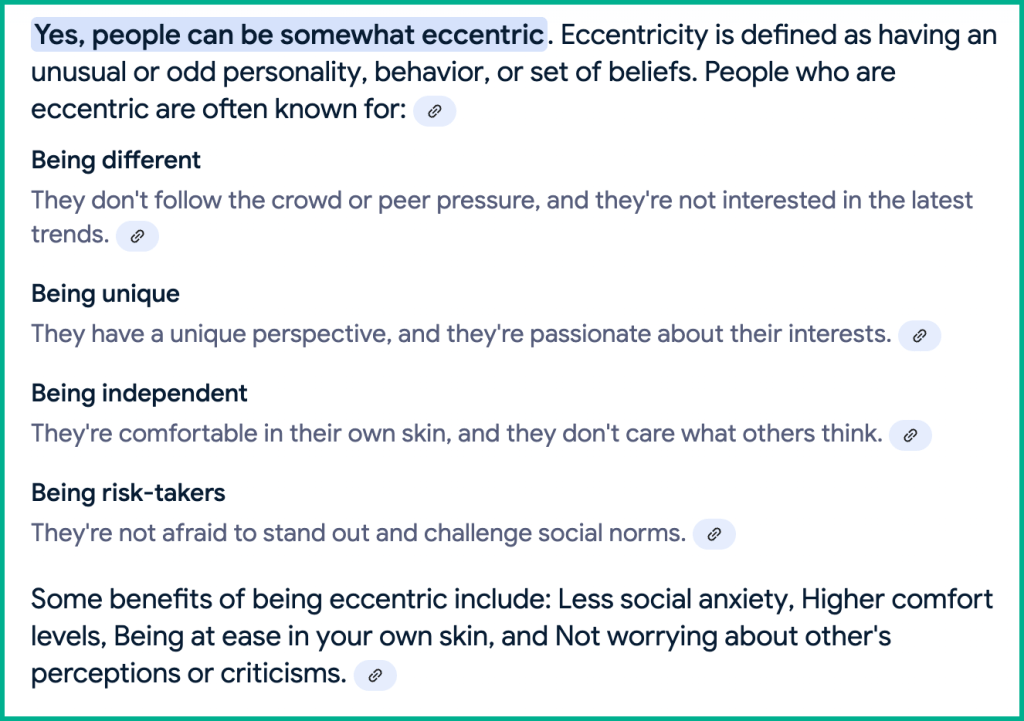
I am grudgingly admitting that the above does a good job of describing this subject. It does seem like I am meeting all those things, and most of the other lists in this project. The one thing I lack is being happy most of the time, I have frequent periods of depression and anxiety. Maybe that’s because I am just not at that point where I have thrown off all the things that generate those types of feeling?
Being eccentric is not a static thing, it becomes more prominent with time, especially for me.
Since eccentricity has not yet been gobbled up by the medical establishment and deemed something that needs to be fixed, I will end this in-depth study by adding another label to myself.
I Am Eccentric & Proud Of It
I want to close out this study by recalling the quote from James Hollis:
To become a person does not necessarily mean to be well adjusted, well adapted, approved of by others. It means to become who you are. We are meant to become more eccentric, more peculiar, more odd. We are not meant just to fit in. We are here to be different. We are here to be the individual.
I have been working hard for the last several years to become the person I was meant to be. I was never meant to just fit it.
 RJ's Corner - Having My Say