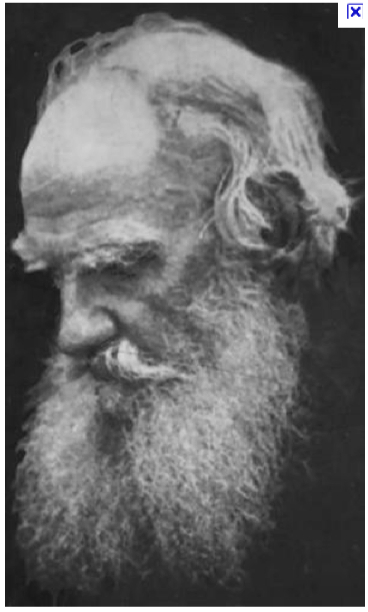
 It is terrible to think what the churches do to men. But if one imagines oneself in the position of the men who constitute the Church, we see they could not act differently. The churches are placed in a dilemma: the Sermon on the Mount or the Nicene Creed–the one excludes the other. If a man sincerely believes in the Sermon on the Mount, the Nicene Creed must inevitably lose all meaning and significance for him, and the Church and its representatives together with it. If a man believes in the Nicene Creed, that is, in the Church, that is, in those who call themselves its representatives, the Sermon on the Mount becomes superfluous for him. And therefore the churches cannot but make every possible effort to obscure the meaning of the Sermon on the Mount, and to attract men to themselves. It is only due to the intense zeal of the churches in this direction that the influence of the churches has lasted hitherto.
The quote above seems pretty radical! It must be from one of those new age thinkers! Guess again. It was from the Author of War and Peace Leo Tolstoy in 1894. Although he says it much more bluntly than I ever would I can’t say I disagree with most of it.
The Nicene Creed which was authored under the Roman ruler Constantine is mostly what we are supposed to believe about Jesus Christ. The Sermon on the Mount is what Jesus himself told us how we are supposed act if we are his followers. Tolstoy saw that the church even during his time put much more energy in maintaining man-made beliefs about Jesus rather than just following Him. Not a lot has changed in that regard. I think almost all clergy are well-meaning men who have simply bought into a tilted system based on beliefs about Jesus instead of lessons from Jesus.
Tony Jones a hundred years later also speaks of this in his book The New Christians: Dispatches from the Emergent Frontier
In the twenty-first century, it’s not God who’s dead. It’s the church. Or at least conventional forms of church. Dead? you say. Isn’t that overstating the case a bit? Indeed, churches still abound. So do pay phones. You can still find pay phones around, in airports and train stations and shopping malls-there are plenty of working pay phones. But look around your local airport and you’ll likely see the sad remnants where pay phones used to hang-the strange row of rectangles on the wall and the empty slot where a phone book used to sit. There are under a million pay phones in the United States today. In 1997, there were over two million. Of course, the death of the pay phone doesn’t mean that we don’t make phone calls anymore. In fact, we make far more calls than ever before, but we make them differently. Now we make phone calls from home or on the mobile device clasped to our belt or through our computers. Phone calls aren’t obsolete, but the pay phone is-or at least it’s quickly becoming so.
Churches are like pay-phones? That is a very interesting analogy. God is not dead. It is only the man-made institution built in his name that is on life support. I have hopes that this new emergent movement will prove to be a worthy substitute for fast dwindling church structures of today. We have to return to doing what Jesus says….
But what do I know…
 RJ's Corner - Having My Say
You always make me think RJ. I am trying to keep myself grounded during this election so I can listen with an open mind. Boy is that hard…I think I am liberal but I am not thinking like an open minded liberal. What is up with that?
b
LikeLike
Hi B. Yes I am always asking “why” even in my senior years. It gets me in trouble sometimes but I just can’t help it. :) I consider myself a social liberal but a fiscal conservative and yes I can live with the apparent dichotomy. We have to take care of the poor but we must do in efficiently. Being a social liberal was taught to me by Jesus, being a fiscal conservative is probably because I am just tight with my own money.
LikeLike
Let me try and tread delicately here, because heaven knows this is a sensitive topic . . .
I have no use for organized religion. I have much use for pursuing my own very personal spiritual journey. I really don’t need a man (or woman) to tell me whether or not I’m on the right path . . . I already know deep in my inner core. When I’m aligned with my inner core (replace with “higher power” if preferred) I’m serene and at peace. When I disregard my inner core, I’m in turmoil.
I’ve studied most of the major religions to a degree, and find much wisdom and overlap in all. As a result, I support finding that path that works for you, and brings you peace. But, please give me the respect to journey in my own way in return, even if it differs for yours. (That would be the general “yours” and not you specifically RJ :-)
LikeLike
Tamara, good for you. There are so many in the world today who just give up on things spiritual. I am glad to hear that you found your path. Thanks also for using caution and respect for others in your comments. As you know if you are a regular viewer of this or my RedLetterLiving blog I am a big believer in finding personal paths to our creator. So many of today’s religions are based on rules of what to believe rather than how to act so I understand your frustration but am not ready to give up on religion quite yet. I have hope that among this new emergent movement some org will step out of the shadows with the real message of Christ.
LikeLike