
My in-depth study of Christianity 18 years ago showed me just how far religion has veered from its original founder. I am now discovering a similar thing happening in the psychiatric community surrounding neurodiversity. That is what this post is all about.

About 8 years ago I discovered that many of my personal traits had a name. It was called Asperger’s Syndrome. At the time the word “syndrome” added to the back of Asperger’s confused me. I was not convinced that I had a disease that caused me to see somethings differently than others. I thought that the traits that I possessed just meant that I was different from others. But I have since discovered that this “syndrome” issue was only the beginning of my concerns.
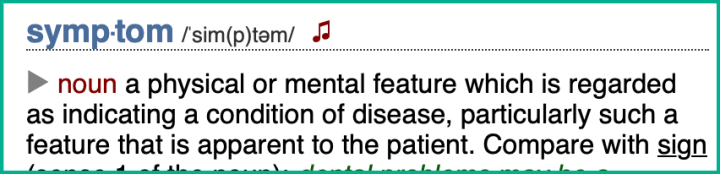
The definition of the word “Syndrome” as shown to the right was contingent upon the word “symptom”, which is also shown to the right.
Let’s get on to the history of what the Psychiatric Association now calls Autism. I will use a timeline for this.
1926 – A Russian psychiatrist writes about six children with what is now considered as Autism.
1938 – A New York psychiatrist detailed 29 cases of childhood schizophrenia (now identified as autism 3)
1944 – An Austrian pediatrician named Hans Asperger. He was foundational to the development of functioning labels (high vs. low-functioning).
1949 – It was claimed that Autism was caused by “refrigerator mothers” described as parents who are cold and detached.
1952 – The first edition of the American Psychiatric Association’s Diagnostic and Statistical Manual of Mental Disorders (DSM), labeled children with autistic traits as having childhood schizophrenia.
1956 – The first study to follow teenagers with Autism
1964 – LGBTQ Conversion Therapy creator begins work on his theory of Applied Behavioral Analysis (ABA) therapy for autistic children.
1965 – Autism Society of America is formed outside the psychiatric community.
1970 – A triad of social interaction, communication, and imagination is considered the core of autism.
1977 – Study written that genetics is an important factor for being autistic.
1980 – The DSM manual entitled Diagnostic and Statistical Manual of Mental Disorders to address infantile autism for the first time.
1990 – Autism is included as a disability category.
2013 – The DSM-5 combines autism, Asperger’s, and childhood disintegrative disorder into autism spectrum disorder by the psychiatric community.
2016 – (CDC) estimates one in 54 children has been identified as having an autism spectrum disorder.
2020 – CDC estimates one in 36 children has been identified as being on the autism spectrum disorder.
If you want to see the complete list click HERE
As you can see, the vast majority of the studies of what is claimed to be “Autism” is limited to children. It also seems obvious that autism as a lifelong characteristic is yet to even remotely be addressed.
Personally, I believe that there is currently no good reason for adults to take on the label of Autism, and a reason won’t emerge until the psychiatric community finally recognizes that the characteristics they are currently labeling as a disorder is simply a result of neurological diversity. It is something that can’t be cured but instead is just a normal part of human makeup.
But this concept of neurodiversity is currently not even in consideration by the psychiatric community. For that reason
I will no longer be using the word “Autism” to describe who I am. Instead I will just say I am “Living on the Margins”
 RJ's Corner - Having My Say